

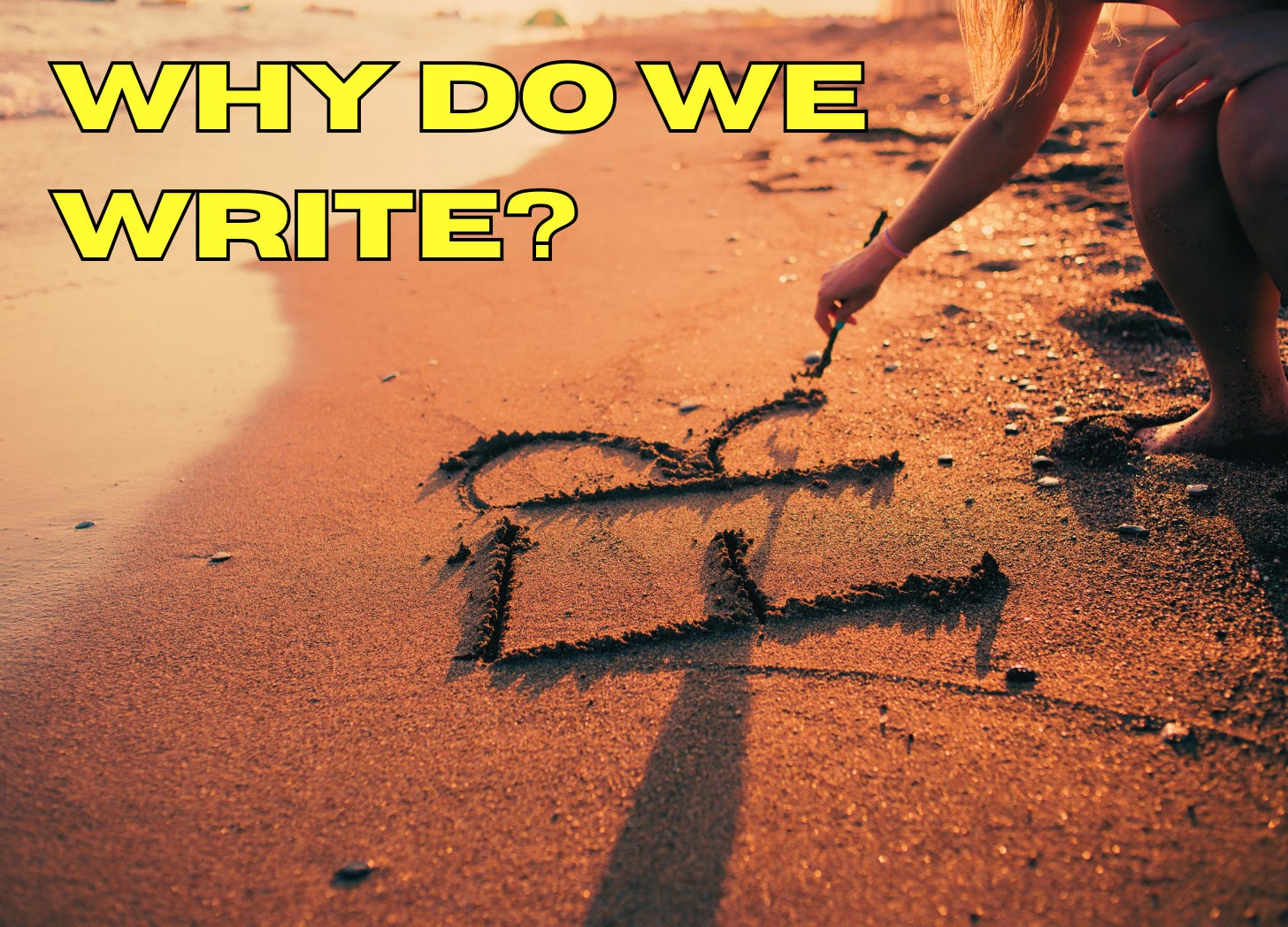
Why do we write?
Every writer's answer may be different, and it will likely change.

Dear Sunshiners,
Why do you write?
This is a question novelists are sometimes asked, and it’s usually novelists who are asked it presumably because the motivations for non-fiction writers are clearer: they want to convey facts or document events.
Sometimes novelists ask it of ourselves too, and of each other. Rachael Johns Author and I have talked about it on our podcast, Dear Rach & Soph – and it’s hard to write that without it looking like a plug, and I suppose it is that, but mainly I just want to state the facts!
Back to the question at hand: Why do I write?
I guess I write because I can. I’ve been doing it since I was a child. I write as a hobby, over at Sunburnt Country Music (another plug-like mention, but they’re hard to avoid), and find I’m happiest doing so when I don’t try to write in a style that seems acceptable to the internet – anyone with an SEO plugin will be familiar with the warnings that come up about sentence lengths and paragraphs being too long and not having subheadings. Too bad. If I want to write a long sentence about why a certain artist is impressive, I’ll do it, and the SEO will suffer but it’s a mug’s game trying to guess what search engines want – and why should we even try? We’re humans, not robots.
The sort of writing – and interviewing – I do at Sunburnt Country Music has informed my writing of fiction, and it took me a while to realise they were motivated by the same thing. And that the thing is related to teaching yoga, which I wrote about in the last issue of The Sunshine Society.

How they’re all related comes down to one simple principle: whether you’re in my yoga class or reading my novel, or watching/listening to a podcast episode I’ve made, I want you to leave the experience feeling better about life and the world than you did when you started.
Students come to a yoga class partly for a workout, I guess, but if that’s all they wanted they could go to an aerobics class instead (do they still exist?). They come to a yoga class because, whether consciously or subconsciously, they want a transformative experience. My yoga teacher, Shiva Rea, refers to herself as a river guide, and while I’m ocean-leaning more than river-fond, it’s something I understand. The river is, in one sense, creative flow. So I’m the river guide too, whenever someone is in my class.
This applies to writing fiction as well. I’m the river guide for the characters and the story, initially. Once they go out into the world in book form, I’m the river guide for the reader. The journey is the reader’s own, but I feel it’s my responsibility to make sure that at journey’s end the reader feels their time has been well spent and that, hopefully, they feel better than they did at the start. That doesn’t mean I write happy endings – I don’t. I write realistic endings, and the feedback from readers is that these are what make them feel better about things. That’s not the reason I keep writing them; the endings are like that because I write about realistic things, and it’s not realistic to tie everything up in a bow. Readers also say the books are comforting, and in this day and age I can’t think of a better compliment.
It feels … not hard, but tender to admit that this is my motivation for writing. Shouldn’t I be saying that I write because I simply have to, that I can’t not write? That it’s my calling/mission and I don’t know who I am without it?
I do know who I am without it, and I could not do it if I wanted to. I don’t want to. I want to tell stories because I know from personal experience that life can sometimes feel unbearable. Everything one knows or believes in can be taken away, trust eroded, even violence committed, and as a consequence facing the day – each day, day after day – is too hard.
From childhood, for me, stories were a refuge. Stories – books – offered me respite and, yes, comfort and they entertained me too. The entertainment was important because it took me away from myself and the world I inhabited, if only for a little while. The stories helped me believe there were other ways to be that might be better. And, having believed that, I created it. Not all at once, and there were times when other people tried to drag me into mires of their own creation, just so they wouldn’t be alone there, but each time I pulled myself out, the world I made became not just bearable but beautiful.
It’s only through doing that work for myself that I can offer it to others, whether teaching yoga, writing about music or creating fiction in book form. It’s a circular chain of offering, in a way: I offer these stories to you in the hope that they’ll leave you better than you were when you started them, and in turn you may encounter someone who feels better for having met you. And I’m not the god-head here: what I am offered by yoga teachers and authors and musicians keeps feeding me so I can keep making my offerings. It’s circular. My job is to keep myself open to what is offered to me so I can pass it on. In other words: to keep out of my own way, a piece of advice I regularly give to writers when asked!
To quote Ben Lee, one of those musicians whose offerings I’ve been accepting for years, we’re all in this together.
Also, I should really mention that I have a novel coming out on 28 July 2026, called The Frock Shop. Here’s the animation for the cover reveal that took place at the end of April. This is a change in design direction, away from the look and feel of my previous novels, but I felt it was time and the publishers agreed. The designer is the same, through: Christa Moffitt of Christabella Designs.
Love,
Sophie

What I’m reading
Even the Good Girls Will Cry by Melissa Auf der Maur: Melissa Auf der Maur was the bass player for Hole, the band fronted by Courtney Love. I was a bass player at the same time as Auf der Maur joined the band – which was in the wake of the deaths of Love’s husband, Kurt Cobain, and Hole bassist Kristen Pfaff – and thought she had the coolest job in music. Plus I saw Hole love on the tour that is mentioned in the book. The nostalgia was a small reason to want to read the book; Auf der Maur’s writing is the reason I’m enjoying it so much.
Vow of Eternal Night by Lily Crozier: I’m doing an in-conversation with Lily at Words on the Waves on the New South Wales Central Coast on 30 May, so I’m listening to the audiobook in preparation.
What I’m listening to
Dusk by Bud Rokesky: Bud is a favourite Australian country music artist of mine and I interviewed him about this, his second album. While the interview is weeks in the past, this album isn’t letting me go.
I’ve also been lucky to have access to some albums in advance of release, including those by Ella Hooper, Amber Lawrence (plus I helped Amber create her book, The Suburban Cowgirl) and Kingswood, three favourite artists/acts. When I was a teenager dreaming of being a music journalist, this is the sort of thing I would not have believed could come true, and I never take it for granted.

Loved this so much!